Order parameters for complex membrane regions
As specified in this section of the manual, gorder can be instructed to only calculate order parameters for bonds inside a region defined by a simple geometric shape — a cuboid, cylinder, or sphere.
In addition, gorder supports composite geometry shapes that can be constructed from the basic ones using logical operations — and, or, and not.
And operator
The and operator combines two geometric shapes so that only the bonds that are inside both of them will be considered for the order parameter calculation.
geometry: !And
  - !Cylinder
    radius: 3.0
    orientation: z
    reference: "Protein1"
  - !Cylinder
    radius: 3.0
    orientation: z
    reference: "Protein2"
In this example, order parameters will only be calculated for bonds that are at the intersection of the two cylinders localized around the proteins. Note that here we must also provide an NDX file with the groups Protein1 and Protein2 defined.
Or operator
The or operator combines two geometric shapes, and only the bonds that are inside either of them will be considered for the order parameter calculation.
geometry: !Or
  - !Cuboid
    x: [3.0, 5.0]
    y: [6.0, 8.0]
  - !Cuboid
    x: [6.0, 8.0]
    y: [3.0, 5.0]
In this example, order parameters will be calculated for bonds that are inside either of the two cuboids defining some rectangular regions of interest.
Not operator
The not operator inverts the geometry of a shape so that only the bonds that are outside it will be considered for the order parameter calculation.
It can be applied to both simple geometric shapes (in which case it mimics the invert keyword) and composite shapes (in which case it inverts the entire geometry).
geometry: !Not
  - !Cylinder
    radius: 2.5
    orientation: z
    reference: !Center
Order parameters will be calculated for bonds that are outside the specified cylinder.
geometry: !Not
  - !And
    - !Cylinder
      radius: 3.0
      orientation: z
      reference: "Protein1"
    - !Cylinder
      radius: 3.0
      orientation: z
      reference: "Protein2"
Order parameters will be calculated for all bonds except those at the intersection of the two cylinders.
More complex shapes
The individual operations can be combined into binary trees to create shapes with arbitrary complexity.
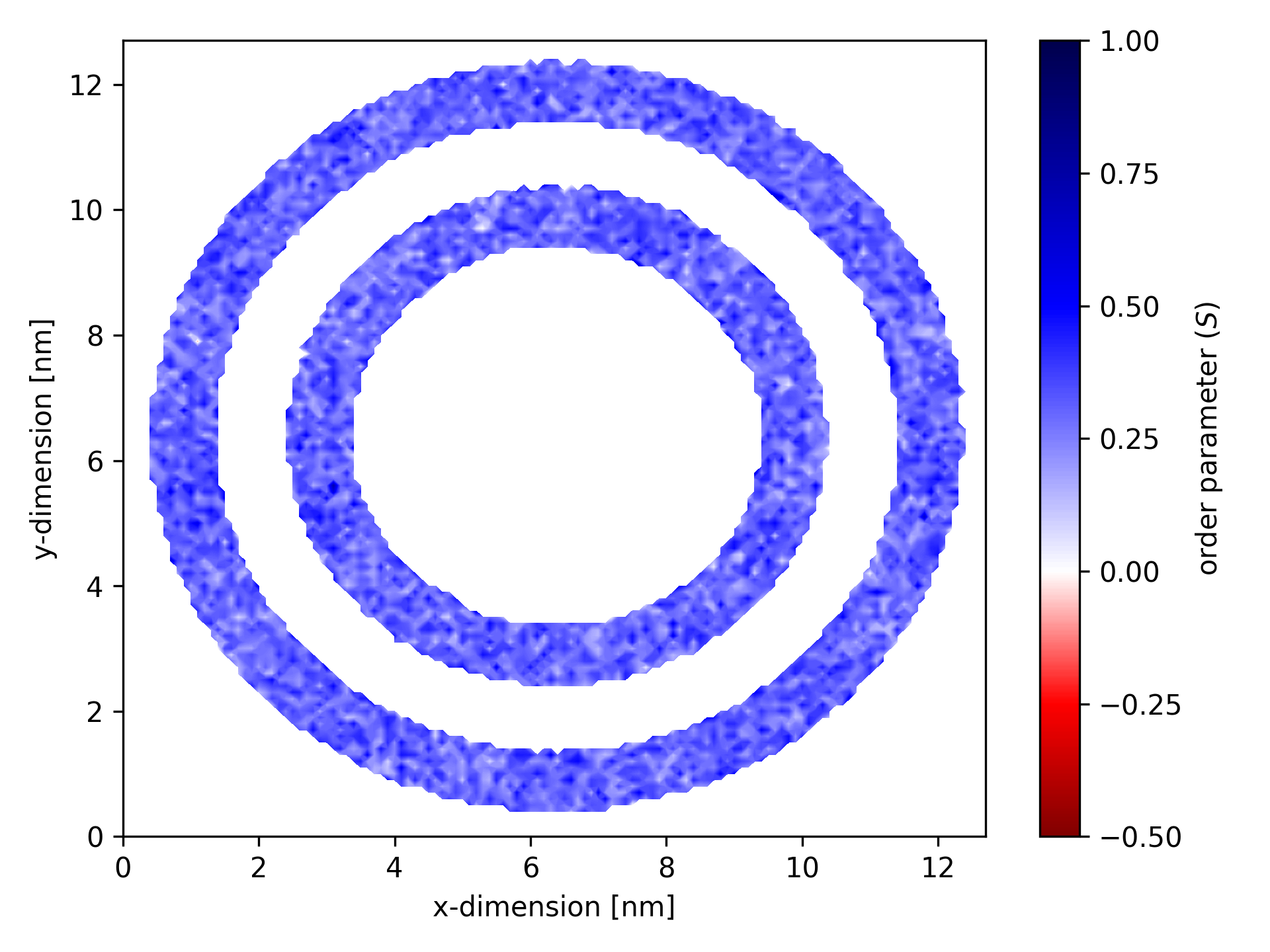
For instance, here we create a region consisting of two concentric rings.
geometry: !Or
  - !And
    - !Cylinder
      orientation: z
      radius: 4.0
      reference: !Center
    - !Not
      - !Cylinder
        orientation: z
        radius: 3.0
        reference: !Center
  - !And
      - !Cylinder
        orientation: z
        radius: 6.0
        reference: !Center
      - !Not
        - !Cylinder
          orientation: z
          radius: 5.0
          reference: !Center
If we plot a map of order parameters, the result may look like this: